What Is ‘Cannabis Price Compression’?

If you have spent any meaningful time in the cannabis industry recently, then you have likely come across the term ‘cannabis price compression.’ It is clearly a hot topic in the industry right now, particularly in less-established markets. However, if you are new to the industry or are just starting to explore opportunities in the industry, you may be less familiar with the very important concept.
Cannabis price compression is fairly straightforward from a definition standpoint. The term refers to a downward trend of wholesale and retail cannabis product prices in a regulated market. But while the definition is straightforward, what causes cannabis price compression is more nuanced, and it is vital for current and aspiring industry members to sufficiently understand the contributing factors involved and to plan their strategies accordingly.
At a basic level, increasing supply leads to lower cannabis product prices, which is a common trend that occurs as markets mature and more cannabis producers obtain licenses, launch operations, and bring their products to market. It is no secret that the cannabis industry is a popular target for entrepreneurs and investors, and they continue to clamor to get in on the action. The economic law of supply and demand applies to the legal cannabis industry just as much as it applies to other large industries, and with more companies entering the industry every year, supply will presumably continue to increase as a result.
Another factor contributing to increasing supply is increasing efficiency and productivity among established producers. Typically, licensed cannabis producers increase their yields as time goes by and they successfully fine-tune their cultivation techniques and operations. They also tend to expand their overall cultivation canopy size and incorporate emerging technology into their strategies, which further increases the amount that they are harvesting each year.
Somewhat of a wild card is home cultivation. Home cultivation is now legal in a lot of jurisdictions where cannabis commerce is permitted, either for medical or recreational use, and that also adds to the overall supply of cannabis products in those markets, albeit outside of the regulated system. When patients and consumers produce their own cannabis at home, it reduces their reliance on regulated retail channels, and that, in turn, reduces overall retail demand.
To what degree market demand is impacted by home cultivation is debatable and hard to pin down, but it clearly happens. The lowered demand then results in increased regulated market competition, and that then contributes to cannabis price compression. As legal cannabis markets mature, cannabis price compression is virtually guaranteed to occur, and companies must calculate for it in their long-term strategies. Companies that refrain from properly anticipating price compression and build their company strategies on an inflated set price model are doomed to fail.
Germany is the largest legal cannabis market in Europe, and the top destination for cannabis exports from other legal markets. Competition is fierce, and so it is no surprise that cannabis price compression is occurring there. It is also happening in other top legal markets in Europe.
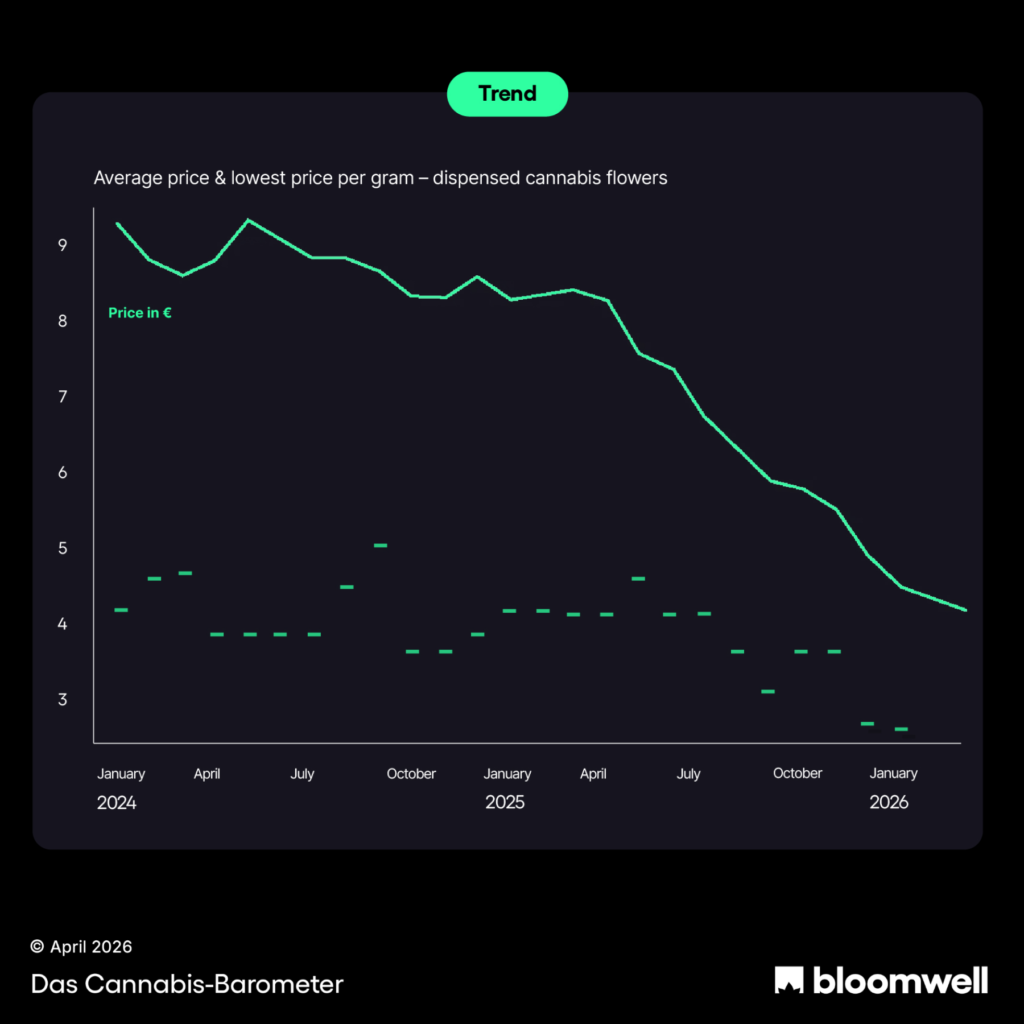
Frankfurt, Germany-based Bloomwell Group, one of Europe’s leading medical cannabis companies, recently surveyed 3,528 medical cannabis patients and determined, among other findings, that the average price being paid for legal medical cannabis flower in Germany was 4.52 euros per gram as of March 2026, down from 5.23 euros per gram in December 2025. The company published a historical graph that further demonstrates how much prices for medical cannabis have decreased in Germany in recent years:
The logical question being asked right now in Germany and other markets where cannabis price compression is occurring is ‘how low will prices go?’ Arguably, the best case study for legal cannabis market price compression is in my home state of Oregon, here in the United States.
Oregon launched legal recreational cannabis sales in October 2015, with medical cannabis sales having already occurred in many parts of the state for several years leading up to the launch of adult-use sales. When adult-use cannabis sales initially launched, it was very common for a gram of high-quality ‘top shelf’ cannabis flower to cost between $15-18 depending on the outlet. I visited dispensaries across the state in late 2015, and that was a standard price in many places. To be sure, some dispensaries had better deals than others at the time, but $15-18 per gram was largely the average price for Oregon’s best cannabis flower.
Zoom forward to today, and legal cannabis flower prices have dropped significantly. The same quality flower that used to sell for $15-18 per gram is now selling for $3-5, and even cheaper if someone is buying larger amounts, or the dispensary is having a deal. An anecdotal example from my own personal experience occurred in April 2024. I traveled to Germany, and personally saw medical cannabis flower that cost $8.16 per gram (calculated from euros to dollars), and I visited my local dispensary when I got back to Oregon, and the same quality of flower cost me only $.72.
To be fair, the price in Germany at the time was based per gram, and the price in Oregon was part of a deal because I bought 28 grams. The Oregon deal was part of a continued 4/20 sale, with the dispensary selling $20 ounces. And also to be fair, Germany’s market is not an apples-to-apples comparison to Oregon for many reasons. However, the same ounce in Oregon carries an everyday price at the dispensary of $40 for 28 grams, which still works out to just $1.43 per gram, which is far lower than the same quality of flower would have sold for in Oregon ten years ago.
Oregon’s cannabis industry price compression experience is not something that should completely deter people from pursuing their business aspirations in the emerging cannabis industry. Just as there are companies in Oregon that weren’t able to survive price compression, there are also others that are succeeding and have even expanded their operations in the competitive Oregon market in recent years. Oregon’s experience provides current and aspiring industry members with opportunities to learn from what has worked and what hasn’t worked as a market matures.
If you want to produce legal cannabis flower, base your strategies and projections on realistic future prices for cannabis. Additionally, if you are trying to launch a company in a sector of the industry that doesn’t involve directly producing cannabis flower, perform proper due diligence to determine how cannabis price compression may impact the product or service that your company will be built upon. For those who wish to dive deeper into the current state of cannabis industry price compression, check out a new report by Whitney Economics and the Global Cannabis Network Collective titled “What You Need to Know: Pricing Compression and Its Impact on International Cannabis Markets“.