How Much Will U.S. Cannabis Companies Save From 280E Tax Reform?

One of the biggest challenges facing the emerging legal cannabis industry in the United States is 280E. Many state-legal cannabis businesses in the U.S. pay a considerably higher tax rate compared to businesses in other industries due to the 280E provision in the federal tax code, with cannabis businesses paying as much as a 70% higher rate in some cases.
Section 280E of the Internal Revenue Code prohibits businesses from deducting certain business expenses from gross income associated with the “trafficking” of Schedule I or II substances, as defined by the Controlled Substances Act. Currently, cannabis is a Schedule I substance at the federal level in the United States.
Whitney Economics (WE), a global leader in cannabis industry economic research, recently announced it has updated its analysis of the negative impact of 280E taxes on U.S. state-regulated legal cannabis operators.
“The amount of additional taxes cannabis operators pay is staggering,” Whitney Economics Chief Economist Beau Whitney said. “In 2025, there was an estimated $2.24 billion in excess cannabis-related federal taxes due to the IRS’s 280E tax policy.”
“Since 2018, the cannabis industry has paid more than $27 billion in federal taxes, of which $15 billion is in excess 280E-related taxes.” Whitney Economics stated in a press release announcing its updated 280E analysis.
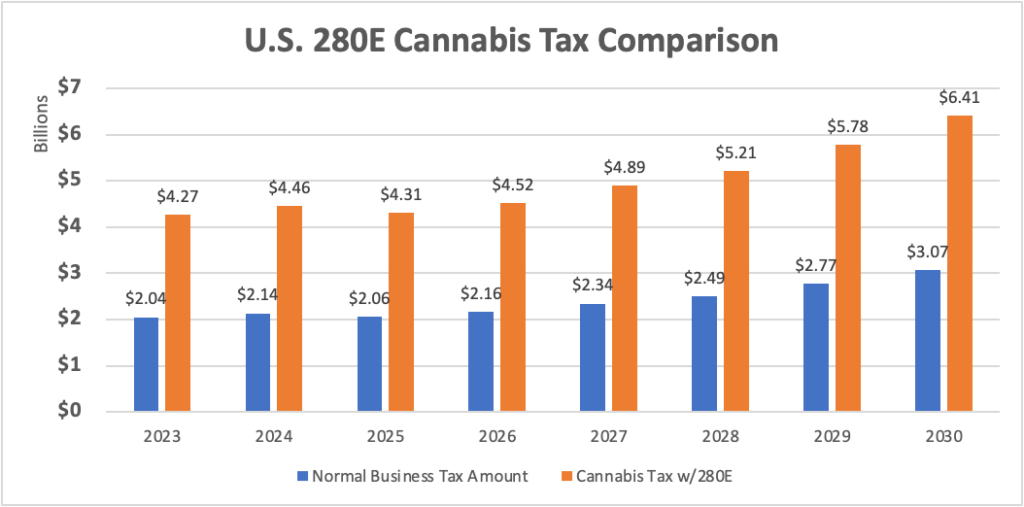
Fortunately, cannabis industry tax relief is on the way. In recent months, United States President Donald Trump ordered the federal government to expedite cannabis rescheduling, from Schedule I to Schedule III. Once the process is completed, it will provide an instant boost to cannabis businesses subjected to 280E.
The impact of 280E reform will not be limited to the legal cannabis industry in the United States. An international ‘butterfly effect’ is virtually guaranteed to occur. The only real question is to what extent the butterfly effect will be.
With cannabis companies in the United States saving billions of dollars annually, presumably, some of those tax savings will be used by U.S. companies to expand their operations to other parts of the world, particularly in Europe. Whitney Economics recently projected that total cannabis sales in legal U.S. states will top $30 billion in 2026.