Approved German Cannabis Cultivation Association Total Increases To 368
Adult-use cannabis cultivation associations are a key component of Germany’s recreational cannabis legalization model. Whereas national adult-use cannabis sales systems are prohibited under current European Union agreements, cultivation associations are in line with EU agreements.
Cultivation associations involve adult cannabis consumers becoming members of the associations and sourcing their cannabis products legally. Prospective cultivation association operators could start applying for licenses with authorities in Germany as of July 1st, 2024. In addition to Germany, cultivation associations are also operating in Malta.
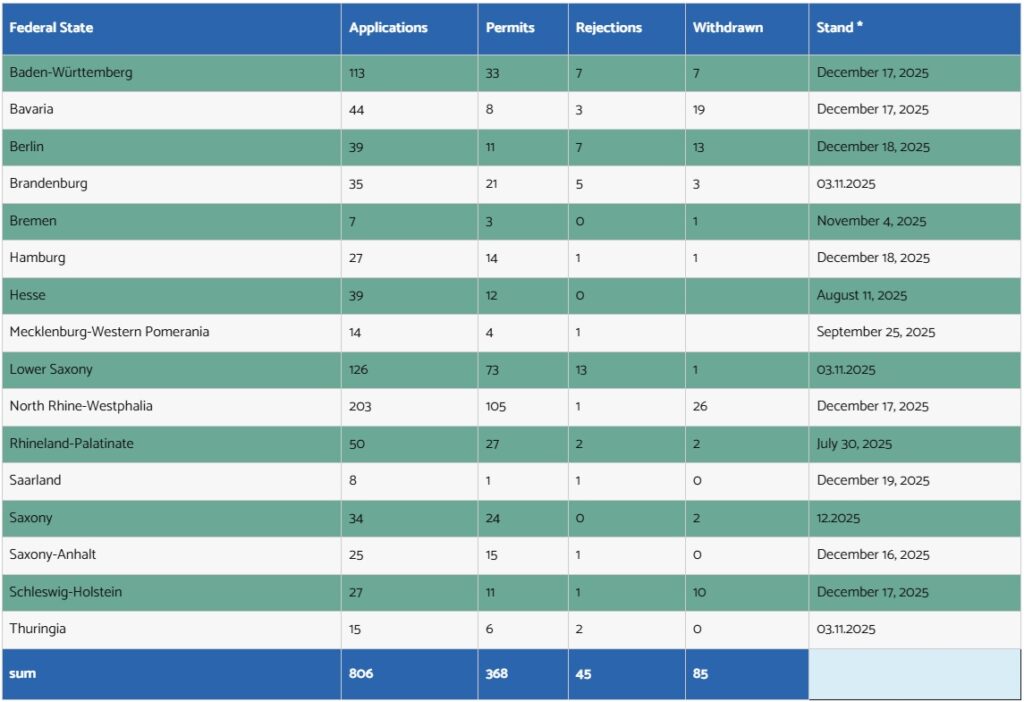
According to the Federal Association of Cannabis Cultivation Associations’ (BCAv) most recent data, 368 cultivation association applications have been approved so far. A total of 806 applications have been submitted nationwide. Below is a data table breaking down where applications have been submitted and approved via BCAv:
A team of academic researchers affiliated with Aarhus University, Centre for Alcohol and Drug Research, Department of Psychology and Behavioural Sciences in Aarhus, Denmark, recently conducted a study examining the regulatory challenges facing Germany’s cultivation association sector. The researchers’ findings were published this month in the International Journal of Drug Policy.
“This study investigates the challenges faced by Cannabis Cultivation Associations (CCAs) in the early phase of the Act’s implementation. Drawing on Administrative Burden and Regulatory Compliance Theory, it examines how burdens and compliance issues shape the establishment and operation of CCAs, and in turn affect the realisation of the law’s stated policy goals.” the researchers wrote about the aim of their investigation.
“Data were collected through a primarily qualitative mixed–methods approach, combining survey responses from 32 CCAs with seven semi–structured interviews with CCA representatives. Survey data were analysed using descriptive statistics, and interview data were coded and analysed thematically.” the researchers wrote about their methodology.
In total, the study identified 8 main regulatory challenges facing Germany’s emerging cultivation association sector. They include:
- The need for a “passionate entrepreneur”
- Funding and financial risks involved
- Locating suitable facilities
- Obtaining an association license
- Unclear legal terminology
- The 200–metre rule
- Prohibitions of on–site consumption
- Ongoing social stigma
“The findings suggest that these challenges create substantial barriers to establishing and operating a CCA, thereby limiting the CCA potential for harm reduction, youth protection, and black–market displacement. Policy adjustments and clearer administrative support structures are needed to prevent exclusion, broaden participation, and support implementation of the Act’s objectives.” the researcher concluded.